
In this in-depth guide, you’ll find everything you need to know about babysitting costs in Finland: average hourly rates, how much to pay based on age, experience, and location, and how extra tasks like cooking or caring for multiple children can impact the rate.
Wondering how much a babysitter costs in Finland in 2026? Whether you’re hiring a teenager for occasional evening care or a professional nanny, babysitting rates vary based on age, experience, and responsibilities. In this guide, you’ll find average hourly rates, real-life examples, and tips to help you set a fair and responsible babysitter salary.
According to recent data from Sitly the average hourly rate for babysitters in Finland in 2026 is around 13 €. This typically reflects informal childcare provided by teenagers or university students, especially during evenings and weekends.
However, babysitting rates vary significantly — ranging from under € 12.00 to over € 25.00 per hour — depending on several key factors like the babysitter’s age, their childcare experience, whether they have first aid certifications, the number and age of children, your location.This figures are based on Sitly’s internal research.
The Type of Babysitter You Hire Makes a Big Difference:
- A professional nanny (with qualifications, regular hours, or live-in arrangements) will typically charge $20 to $30+ per hour, or may receive a monthly salary
- A 16-year-old high school student providing casual babysitting once or twice a week may ask for a lower rate
When setting a fair rate, it’s important to consider not just the time spent, but also the level of responsibility involved. Caring for infants or multiple children, handling bedtime routines, or preparing meals are all tasks that usually justify a higher rate.
Is there a minimum wage for babysitters in Finland?
Unlike in many other countries, Finland does not have a general statutory minimum wage covering all sectors. The law therefore does not set a specific minimum hourly rate for childcare work.
In most sectors, the minimum wage is based on collective agreements (TES), which are sector-specific. A TES applies to employees when an agreement has been made with the employer, or when the sector falls under a generally binding agreement. Childcare work — especially when hired by a private individual — is most often not covered by such an agreement, and no exact minimum wage has been defined for it.
In this case, the employer (e.g. the family) and the childminder must agree on the pay between themselves, taking into account the demands of the work, level of experience, and local practices. However, the employer has an obligation to pay what is known as “customary and reasonable pay,” which corresponds to the compensation generally paid for similar work.
Hourly vs. Fixed Babysitting Rate: What’s Common?
The most common way to pay a childminder in Finland is an hourly rate. It’s simple, clear, and fair: you pay exactly for the time the caregiver spends with the children. This works well when you need help occasionally, at varying times, or on short notice.
However, there are situations where a fixed fee — weekly or monthly — can be more practical for both you and the caregiver. For example, if the caregiver takes the children to daycare every weekday morning or looks after them on a specific evening each week, agreeing on a fixed fee makes managing finances and planning the work easier.
So how do you choose between an hourly rate or a fixed fee?
An hourly rate is the best option when you need care irregularly. For example, if you get home from work at different times each day, need help unexpectedly, or extra tasks may arise for the caregiver. An hourly rate guarantees that you pay exactly for the time the caregiver spends with the children, and it often motivates the caregiver to be flexible as needed.
A fixed monthly or weekly fee suits better when the childminder’s schedule is fixed (e.g. every Saturday evening), routines are predictable, and it’s a longer-term working relationship. A fixed fee makes budgeting easier and offers the caregiver financial stability.
What to consider if you pay a fixed fee?
For clarity, define in advance what the fixed fee includes: for example, the number of hours, the days of the week, and the tasks. Also agree on extra compensation for unexpected situations, such as overtime, overnight stays, or travelling with the family. The fixed fee must cover all the agreed working conditions. For example, if the caregiver comes every Saturday, but you decide to stay home on one particular Saturday, the pay must still be paid — that’s part of the mutual agreement.
Example: you could agree on a fixed fee of €40 for one five-hour evening, where the children go to bed early and the caregiver doesn’t need to do anything else while they sleep. If instead you ask them to come earlier, prepare dinner, or stay later, it’s fair to add hourly-based compensation.
How Experience and Qualifications Affect Babysitter Rates
A babysitter’s experience, training, and certifications significantly affect their expected rate— and justifiably so.
It’s not just about age. A 24-year-old student with a qualification in early childhood education or a children’s first-aid certificate will naturally ask for higher pay. But a 19-year-old with extensive experience working with different children can also reasonably ask for more than the generally paid minimum in the field.
In general: the more skilled or qualified the babysitter, the higher their expected rate. It’s a personal decision. As a parent, you get to decide what feels right for your situation:
- Are you comfortable hiring someone who’s just getting started — and paying a bit less while they gain experience?
- Or do you prefer someone with professional background, and are willing to pay more for added peace of mind?
There’s no one-size-fits-all answer — just an agreement that works for both of you. If you’d like a guideline to help calculate fair babysitting wages, check the visual reference below. Also, check out our Babysitter Rate Calculator to get a sense on what to pay, based on tasks.
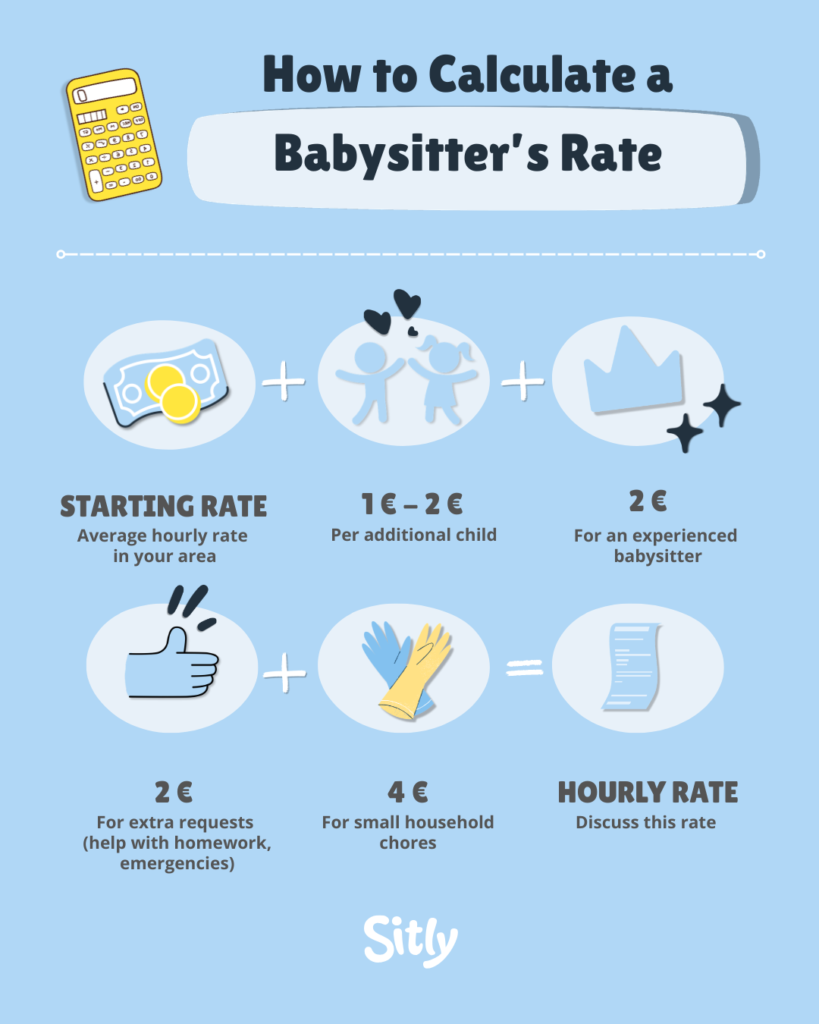
What Tasks Does Your Babysitter Handle?
The hourly rate for a babysitter in Canada doesn’t just depend on their age or experience — it also depends on what you ask them to do during the job. If your babysitter is taking on extra responsibilities, it’s fair to reflect that in their pay.
Examples of tasks that may justify a higher rate:
- Caring for multiple children: Managing two or three kids at once is a lot more demanding than watching one child. Expect to pay more for this.
- Special care needs: If your child has medical conditions, behavioural challenges, or simply requires constant attention, a higher hourly rate is entirely appropriate.
Example: Sara, 19-year-old babysitter in Helsinki
Sara is 19 years old and already has plenty of childcare experience. She’s studying to become a teacher and has completed a children’s first aid course. Once a week Sara works for a family with three children (aged 8, 5, and 3). She arrives at 4 pm, first picks up the youngest child and then the older children. The children have a snack and play at home, and weather permitting Sara takes them to the nearby park. Before the parents return home around 7:30 pm, she prepares dinner and makes sure everyone eats.
How much should Sara earn?
In this example, Sara receives extra compensation on top of her base pay:
- €14.00/hour = general hourly rate for an experienced babysitter
- + €2.00/hour = extra compensation for caring for two additional children (three children total)
- Total: €16.00/hour
If the care shift lasts 3.5 hours, the total pay would be: €16.00 × 3.5 hours = €56.00. This is fair compensation that takes into account responsibility, experience, and the scope of the tasks.
Babysitting Babies vs. Older Kids
The age of your children plays an important role when deciding on a fair babysitting rate. Caring for a baby or toddler is hands-on, non-stop work. The sitter needs to be constantly attentive — feeding, changing, comforting, and engaging with the child. This level of care justifies a higher hourly rate.
With children aged six and up, things are usually simpler. They can eat on their own, use the bathroom independently, and often entertain themselves. This reduces the sitter’s workload, and the rate may reflect that.
In general: the younger and more dependent the child, the higher the level of responsibility — and the pay — should be.
Household Tasks and Light Cleaning
If you ask your babysitter to take on household chores in addition to caring for your children, it’s reasonable to increase the rate.
Tasks that may justify a higher babysitting rate include:
- Vacuuming common areas
- Loading or unloading the dishwasher
- Folding laundry
- Washing dishes
- Preparing dinner
Since the average pay for home cleaners in Finland can be €15–25/hour depending on the demands of the work and the area, it’s entirely reasonable to pay the caregiver extra if they also help with housework.
Evening Babysitting vs. Daytime Babysitting
Do you need a childminder only in the evenings? Or are you looking for someone who picks the children up from school and spends the whole afternoon with them? Evening work is often paid somewhat better, since it falls outside regular working hours and sometimes requires more flexibility.
Day or afternoon work can include several practical tasks, such as picking children up from school or daycare, taking them to hobbies, preparing an evening snack, supervising play, and handling evening routines such as bathing and bedtime.Tip: Some parents choose to adjust the rate after 8:00 PM, when the children are usually asleep — or agree on an average flat rate that balances busy and quiet hours fairly.
Example: Giulia, 19-year-old evening baysitter
Giulia is a 19-year-old university student with two years of childcare experience. She started out by helping look after her little brother and cousins. Giulia occasionally works as an evening caregiver on weekends. When she arrives at 7:30 pm, the children have already eaten. Her task is to put them to bed around 8:30 pm. After that she stays with the family until 11:30 pm, when the parents drive her home. The only extra task of the evening is emptying the dishwasher. The rest of the time she can rest, since the children are asleep.
How much does Giulia earn?
Giulia and the parents agree on an hourly rate of €13.00, which takes into account the children’s early bedtime and the babysitter light workload.
Total for the evening:
€13.00 × 4 hours = €52.00
Giulia is happy with the arrangement: the evening goes smoothly and the pay feels fair. The parents are also happy, because they know they’ve agreed on compensation that suits the situation and is clear.bilities.
Last-Minute or On-Call Babysitters
Need a babysitter on short notice? That kind of flexibility often comes with a higher price. Spontaneous bookings — especially for morning care or during unexpected situations — may require the babysitter to cancel personal plans or rearrange their day. When this happens, it’s respectful to offer a slightly higher hourly rate. Last-minute availability is convenient for you, but it should be rewarded fairly.
Example: Stella, backup babysitter for emergencies
Stella has an arrangement with one family: she acts as a backup babysitter for emergencies in the mornings. One morning at 6:45 am, Lorenzo’s mother calls — Lorenzo has a fever and can’t go to daycare, and the mother has an important work meeting. Stella arrives at 8:00 am and stays with Lorenzo until 1:00 pm, when the grandmother comes to continue the care.
How much does Stella earn?
Base hourly rate: €13.00 (typical for an experienced caregiver without a formal contract)
– + Emergency surcharge: +€2
→ Total: €15.00/hour
5-hour shift: €12.00 × 5 = €75
Hourly Babysitting Rates by City in Finland
To help you understand what a fair rate might be for your babysitter, here are the average hourly rates reported by Sitly babysitters aged 16 to 21, based on their public profiles on the platform. These figures reflect the average rates that babysitters themselves request — not what families necessarily pay — and are a useful reference for setting expectations in your area.
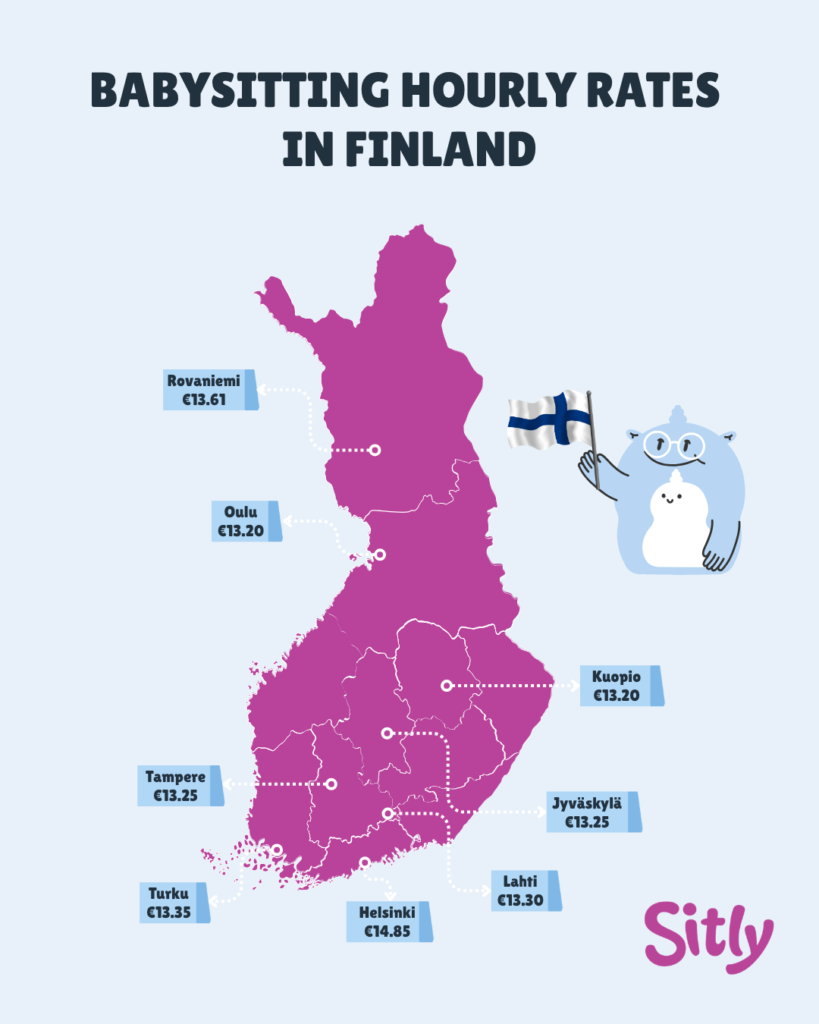
As you can see, based on this Sitly data, hourly rates vary between cities in Finland: in Helsinki it’s around €14.87/h, in Rovaniemi €13.61/h, in Turku €13.35/h, and in Tampere €13.26/h. These figures give a good general picture of the kind of rates childminders can ask families for in different parts of the country.
But these averages don’t mean that a childminder in your specific city will always charge the same amount — or that childcare is automatically cheaper in southern Finland than in the north. A more experienced and qualified caregiver can ask for a higher hourly rate even in areas where the average is lower. In summary: averages help give a sense of the price level, but the actual rate always depends on who is providing the care, where the care takes place, what tasks the caregiver does, and what you can or want to pay.
Average hourly rate for childminders in Finland
| City | Hourly rate |
|---|---|
| Rovaniemi | €13.61 |
| Oulu | €13.20 |
| Tampere | €13.25 |
| Turku | €13.35 |
| Helsinki | €14.85 |
| Lahti | €13.30 |
| Jyväskylä | €13.25 |
| Kuopio | €13.20 |
So, What Should You Pay a Babysitter in Finland?
There’s no universal answer when it comes to babysitting rates — and that’s because every situation is different. The right amount to pay depends on a mix of factors, including:
- The babysitter’s age, experience, and any certifications (like First Aid or CPR)
- The number of children and their ages
- Whether extra tasks are involved, such as preparing meals, helping with homework, or light cleaning
- Whether the care takes place during the day, in the evening, or involves overnight stays
- Your location — rates in big cities are often higher than in smaller towns
- And of course, your personal budget
In the end, it’s about finding the right balance between fair compensation and reliable, affordable care for your family. The most important ingredient? Clear communication. Talk openly with your babysitter about what you expect and what you’re able to offer. When both sides are on the same page, it’s easier to agree on a rate that feels fair and sustainable.
Table of contents


FAQ

In Finland, hourly pay for babysitters varies quite a bit. Generally, the rate range is between 10 and 15 euros per hour for occasional work. Pay can be higher if the babysitter has experience, if she is caring for a child with special needs, or if she works in the evening or on weekends.
Yes. In the Helsinki metropolitan area, and in Helsinki in particular, hourly babysitting rates are generally 1–3 euros higher than in the rest of Finland.
The reasons include a higher cost of living and greater demand for flexible childcare services.
A babysitter usually costs €15–20 per hour on weekends, since evening and weekend shifts are paid at a higher rate.


Trusted sitters, right around the corner
Need a little help? Sitly connects you with experienced babysitters in your area. Whether you need occasional or regular care, finding the right babysitter is super easy. Browse profiles, read reviews, and reach out to your favorites right away.

Related Articles

When is a baby old enough for a babysitter?
Wondering when your baby is old enough for a babysitter? While there’s no single “right” age, short and gradual separations are possible even in the early months when the babysitter is experienced and routines are respected.

Calculate Your Babysitter’s Rate with the Sitly Calculator
Find out how much to pay a babysitter in your area. Sitly’s Babysitter Rate Calculator shows average rates across Finland and helps you estimate a fair hourly wage based on your city, number of children, and any extra duties.

10 Ways to Help Your Child Overcome Fear of Monsters at Bedtime
If your child is afraid of monsters at bedtime, you’re not alone. Many kids aged 3 to 6 struggle with nighttime fears fueled by imagination and change. In this article, you’ll learn why these fears happen, how to validate them, and 10 simple, creative ways to help your child feel safe and sleep peacefully. From using nightlights and comforting routines to anti-monster sprays, magic spells, and stuffed animal bodyguards—each idea is designed to reduce anxiety and empower your child at night.