
Are you working as a babysitter or planning to start? This guide covers the updated 2026 rates in Finland, the average hourly pay, and practical examples to help you calculate how much to charge based on your experience, location, and work schedule.
Just started babysitting and not sure what to charge? Or maybe you’ve been at it for a while and want to know if your rate is fair? In Finland , the average hourly rate requested by babysitters in 2026 is around 13 €, according to Sitly’s recent data based on the rates set by the over 16,000 babysitters registered on the platform across the country.
But this is only an average: the actual pay can vary widely depending on your city, your experience, the number of children you care for, and the type of responsibilities involved. In this guide, you’ll find everything you need to understand how much to charge as a babysitter, how to calculate your babysitting rate, and when it’s reasonable to ask for a higher wage.
How Much Does a Babysitter Earn per Hour?
How much does a babysitter earn per hour? As already mentioned, the average hourly rate for babysitters in Finland is around 13 euros per hour, according to data collected by Sitly. However, this is only an indicative average — your own rate may be higher or lower depending on the situation and the demands of the work.
- Average hourly pay (private/family work): typically ranges between €10 and €15 per hour for young or less experienced babysitters.
- Qualified babysitters or those hired through an agency: if the babysitter has specific qualifications (e.g. early childhood educator, first aid) or is hired through an agency, the rate rises to between €15 and €25 per hour.
Several factors affect how much a babysitter earns per hour: the city you work in, your own experience and skills, the age and number of children, the time of day you work (daytime or evening), and whether it’s occasional or regular work.
Example: Sara, 19-year-old babysitter, 3 children and cooking
Sara is 19 years old and already has plenty of childcare experience. She’s studying to become a teacher and has completed a children’s first aid course. Once a week Sara works for a family with three children (aged 8, 5, and 3). She arrives at 4 pm, first picks up the youngest child and then the older children. The children have a snack and play at home, and weather permitting Sara takes them to the nearby park. Before the parents return home around 7:30 pm, she prepares dinner and makes sure everyone eats.
How much should Sara earn?
In this example, Sara receives extra compensation on top of her base pay:
– €14.00/hour = general hourly rate for an experienced babysitter
– + €2.00/hour = extra compensation for caring for two additional children (three children total)
– Total: €16.00/hour
If the care shift lasts 3.5 hours, the total pay would be: €16.00 × 3.5 hours = €56.00. This is fair compensation that takes into account responsibility, experience, and the scope of the tasks.
Hourly Babysitter Pay in Major Cities
One of the most important factors is where you work: babysitting rates can vary significantly from city to city. For example, in Helsinki and Espoo a babysitter usually earns more than in Oulu or Jyväskylä, but the rate always depends on the content of the work and experience.
Take a look at the image below to see how much babysitters earn in different areas in Finlands.
Infographic: How Much Babysitters Earn in Finland
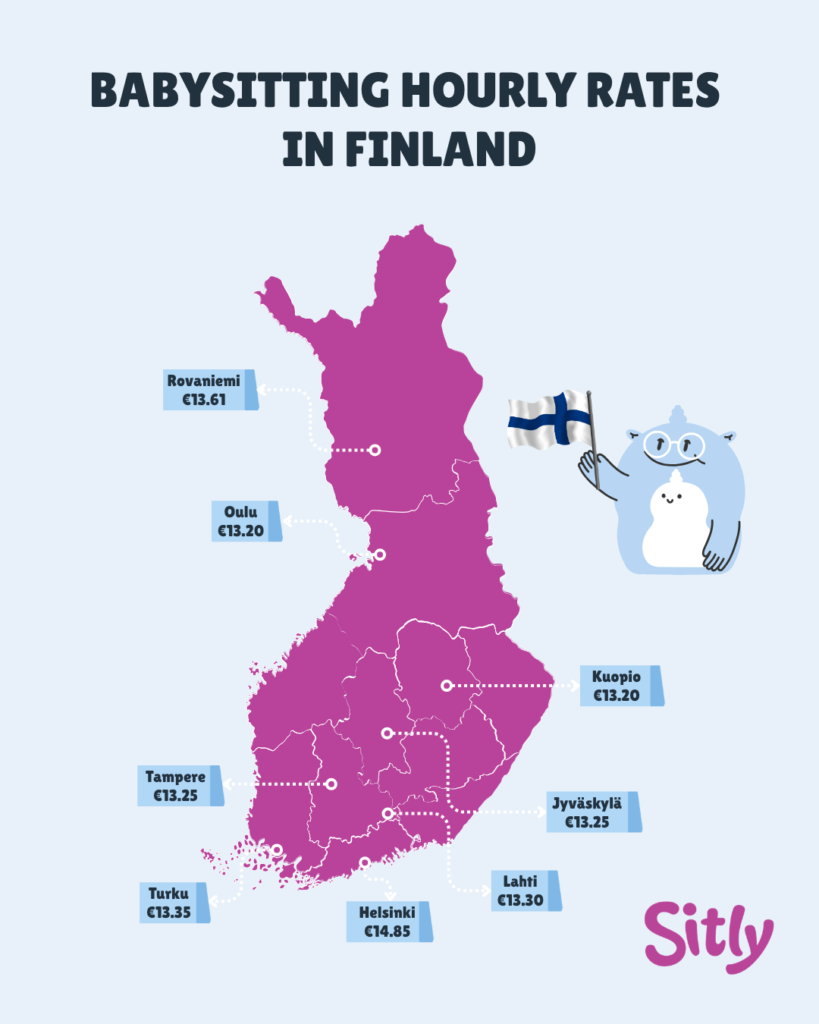
Average babysitters’hourly rate in Finland
| City | Hourly rate |
|---|---|
| Rovaniemi | €13.61 |
| Oulu | €13.20 |
| Tampere | €13.25 |
| Turku | €13.35 |
| Helsinki | €14.85 |
| Lahti | €13.30 |
| Jyväskylä | €13.25 |
| Kuopio | €13.20 |
Calculating Babysitter Pay
Beyond where you work, there are many other factors that can increase how much you earn as a babysitter: your experience, qualifications, the number of children you look after, and any extra tasks the family asks you to do. All of these influence your final pay and your hourly babysitting rate.
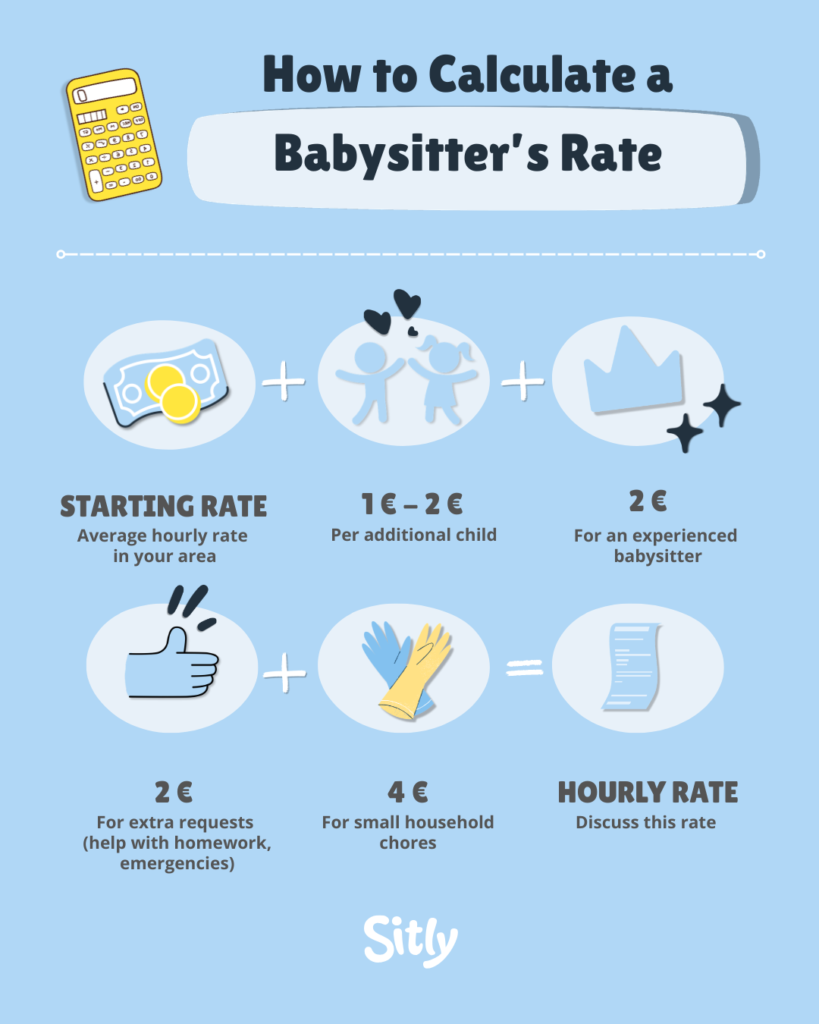
The infographic below helps you calculate a realistic hourly rate based on the work you do for the family.
Infographic: How to Calculate Babysitter Pay
Try the Sitly calculator to instantly see babysitter rates in your area. Enter your city, the babysitter’s tasks, and the number of children, and get an immediate average rate.
How Much Does an Experienced or Qualified Babysitter Earn
If you’ve been working with children for years or have specific training (such as early childhood education, childcare assistant certifications, or first aid), you can charge more than the basic rates. Families are generally willing to pay higher wages when they see professionalism, confidence, and strong childcare skills.
How Much Does a Babysitter Earn per Hour for Two Children
When you take care of two or more children, your hourly rate can increase by 10–20% compared to your base rate, depending on the level of effort required. Caring for two young siblings, for example, requires more attention and energy than looking after one older child. And if the children have very different ages, managing their needs and finding suitable activities for both can be even more challenging.
Hourly Pay for Babysitters Who Do Light Household Tasks
Tidying up the playroom, preparing a child’s lunch, washing the dishes used by the children, or folding their clothes are considered part of your babysitting duties.
However, if the family asks you to help with additional household tasks (such as folding the family’s laundry, dusting, or vacuuming), these are extra responsibilities that should be paid separately.
How Much Does a Babysitter Earn in the Evening or Overnight
Evening babysitting is usually paid a bit more, because working in the evening or at night involves less convenient hours. In general, for evening or overnight babysitting you can charge 10–20% more than your daytime rate. For example, if you earn €13 per hour during the day, you could ask for €14–15.50 per hour in the evening, especially if you stay overnight at the family’s home or the work takes place after 10 pm.
However, it also depends on the level of responsibility required. If you arrive when the children have already had dinner, go to bed shortly after, and sleep peacefully through the night, you might accept a slightly lower rate. But if the children are very young, wake up often, or need frequent attention during the night, it’s fair to ask for a higher wage.
Tip: Always agree in advance with the parents on safety arrangements for getting home at night. Will they drive you home? Will they pay for a taxi? Or walk you to your car? Your safety must always come first — and it should be a shared responsibility between you and the parents.
Example: Giulia, 19-year-old evening baysitter
Giulia is a 19-year-old university student with two years of childcare experience. She started out by helping look after her little brother and cousins. Giulia occasionally works as an evening babysitter on weekends. When she arrives at 7:30 pm, the children have already eaten. Her task is to put them to bed around 8:30 pm. After that she stays with the family until 11:30 pm, when the parents drive her home. The only extra task of the evening is emptying the dishwasher. The rest of the time she can rest, since the children are asleep.
How much does Giulia earn?
Giulia and the parents agree on an hourly rate of €13.00, which takes into account the children’s early bedtime and the babysitter light workload.
Total for the evening:
€13.00 × 4 hours = €52.00
Giulia is happy with the arrangement: the evening goes smoothly and the pay feels fair. The parents are also happy, because they know they’ve agreed on compensation that suits the situation and is clear.
Babysitter Pay: Hourly Rate or Flat Fee?
Is it better to get paid by the hour or with a flat fee? It depends on the type of work you do for each family. For occasional jobs or when schedules change frequently, it’s better to agree on an hourly babysitting rate — you get paid only for the hours you actually work.
If instead you work regularly for one family, a fixed monthly fee can be convenient. In that case, it’s important to clearly define what is included in that monthly amount. For example:
- If the family doesn’t need you one day, do you still get paid?
- If something unexpected happens and they ask you to stay two extra hours, will those hours be paid separately?
- And what happens if you normally work on Tuesdays but there are five Tuesdays in a month?
Tip: Clarify these details in advance to avoid misunderstandings and maintain a calm, professional relationship with the family.
Last-Minute Babysitter Rate for Emergencies
What if the family calls you at the last minute because of an emergency? Maybe early in the morning because their child woke up with a fever. In most cases, you can ask for a higher rate (10–20% more) for last-minute requests.
It’s best to agree ahead of time on an “emergency rate” that applies whenever you’re asked to step in unexpectedly. This keeps everything clear and ensures your flexibility is fairly compensated.
Example: Stella, backup babysitter for emergencies
Stella has an arrangement with one family: she acts as a backup babysitter for emergencies in the mornings. One morning at 6:45 am, Lorenzo’s mother calls — Lorenzo has a fever and can’t go to daycare, and the mother has an important work meeting. Stella arrives at 8:00 am and stays with Lorenzo until 1:00 pm, when the grandmother comes to continue the care.
How much does Stella earn?
Base hourly rate: €13.00 (typical for an experienced caregiver without a formal contract)
– + Emergency surcharge: +€2
→ Total: €15.00/hour
5-hour shift: €12.00 × 5 = €75
How Much Does a Babysitter Earn per Month
A babysitter’s monthly income can vary greatly depending on the number of hours worked and their level of experience. A part-time babysitter working, for example, around 20 hours a week usually earns around €900–1,200 per month.
If, on the other hand, you work full-time and have training or experience with babies or children with special needs, pay can rise above €1,800 per month.
How Much Does a Babysitter Earn per Day
If you work only on certain days — for example during school holidays or when parents travel for work — you can agree on a daily rate instead of an hourly one. The calculation is simple: multiply your hourly rate by the number of hours worked. An 8-hour day is typically worth between 100 – 120 €, but the amount may be higher if you look after very young children, prepare meals, or stay into the evening.
Tip: Be clear with the family about your schedule, what tasks you will handle during the day, and how extra hours will be paid if you need to stay longer due to an unexpected change.
How to Set Your Babysitting Rate
To determine your hourly rate, you need to consider several factors:
- your qualifications and experience
- the number and ages of the children
- the average rate in your area
- the time of day you work (daytime or evening)
- the responsibilities the family expects you to take on
Once you’ve identified the rate that feels right for you, the next step is to discuss it openly with the family. It might feel a little awkward at first, but being clear about pay from the beginning is the best way to avoid misunderstandings and start the working relationship on the right foot.
A good approach is to come prepared: research the rates in your area and explain calmly during the conversation why your rate makes sense — for example based on the children’s ages, the schedule, or any extra tasks. You can also ask the family what amount they had in mind. This makes the discussion more open and transparent, making it easier to reach a fair agreement that works for both sides. Need more tips? Read are blog on how to become a great babysitter.
Table of contents


FAQ

In Finland, hourly pay for babysitters varies quite a bit. Generally, the rate range is between 10 and 15 euros per hour for occasional work. Pay can be higher if the babysitter has experience, if she is caring for a child with special needs, or if she works in the evening or on weekends.
Yes. In the Helsinki metropolitan area, and in Helsinki in particular, hourly babysitting rates are generally 1–3 euros higher than in the rest of Finland.
The reasons include a higher cost of living and greater demand for flexible childcare services.
Start from the average rate in your area. From there, add €1–3 per hour if you have a lot of experience or training or childcare studies. For each additional child you look after, add €1–2 per hour. If you take on extra tasks, such as cooking, evening housework, putting the children to bed, or helping them with small tasks at home, add another €1–2 per hour for these. Finally, keep in mind that evening, weekend, and last-minute requests may justify a surcharge of €2–5 per hour.


Flexible babysitting jobs, just around the corner
Love spending time with kids? Become a Sitly Sitter! We connect you with families looking for a reliable sitter. Set your own schedule, choose your rates, and meet families nearby. Get started today!

Related Articles

Calculate Your Babysitter’s Rate with the Sitly Calculator
Find out how much to pay a babysitter in your area. Sitly’s Babysitter Rate Calculator shows average rates across Finland and helps you estimate a fair hourly wage based on your city, number of children, and any extra duties.

19 Easy Part-Time Jobs as a Student — from Babysitting to Tutoring and Private Lessons
Seeking to earn some extra money as a student or in addition to your current job? Finding the right part-time work can provide you with the flexibility to earn an income while still focusing on school and your personal life. In this guide, we’ve rounded up19 of the best and most flexible side jobs. Many of them can be done from home, like filling out online surveys, babysitting, or tutoring, while others let you get outside, be creative, or meet new people.

How to Become a Great Babysitter
If you want to become a babysitter and find regular work, the key is to build experience, gain parents’ trust, and show that you take the role seriously. Even if you’re young, you can start by helping family members, offering to work as a “mother’s helper,” taking a First Aid and CPR course, and creating a professional babysitter profile on a platform like Sitly. By setting a fair hourly rate based on your age, experience, and responsibilities, and by going the extra mile during each job, you’ll increase your chances of getting more babysitting work and keeping parents happy.